
The BIM methodology has various levels of implementation, each of which brings different operational benefits as well as challenges.
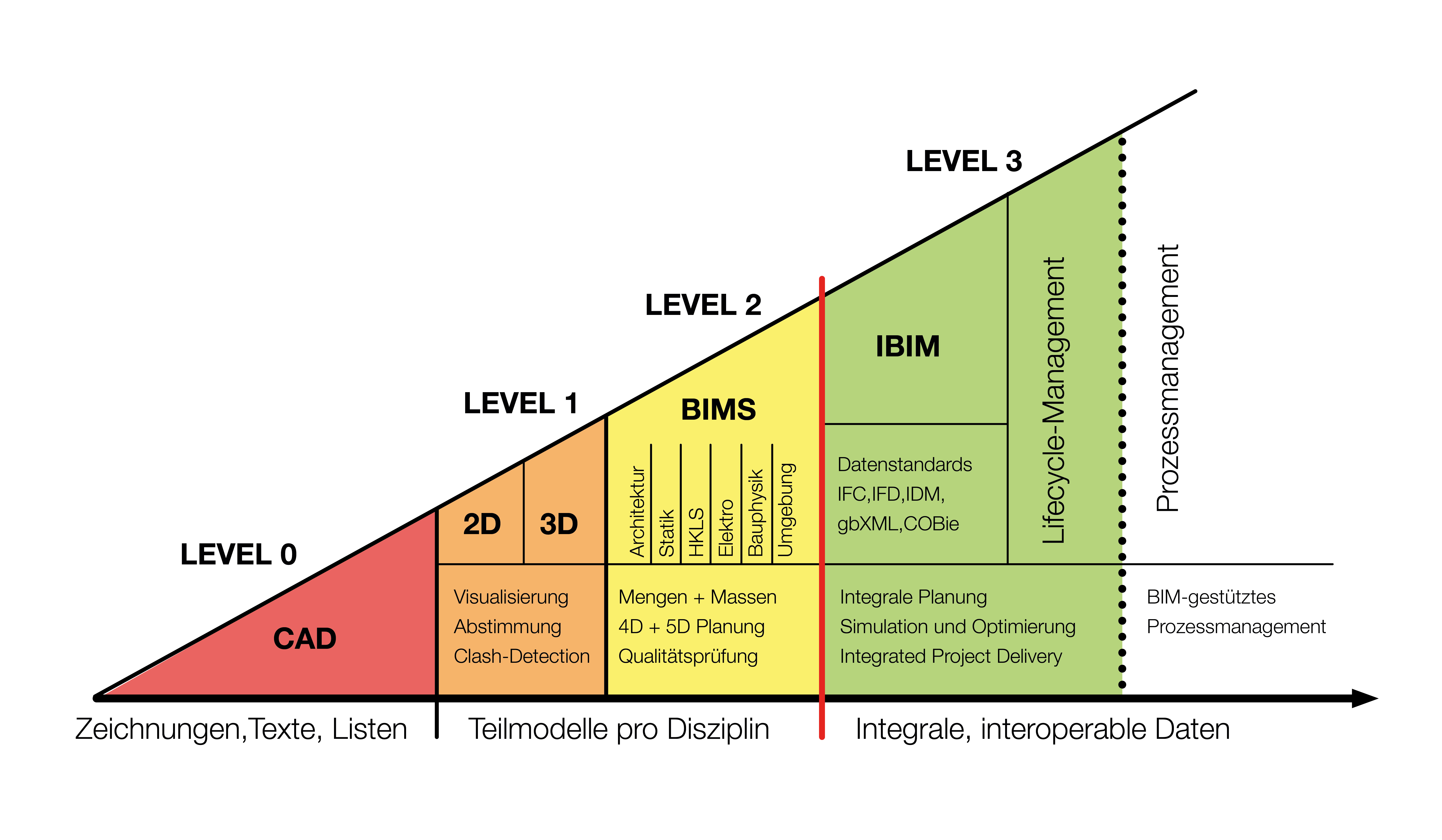
The literature describes three BIM levels*, which are typically represented in this triangle:
- Level 0 (excluded): CAD -> Drawings (plans), texts, lists
- Level 1 BIM: 2D, 3D; BIMS -> Submodels per discipline
- Level 2 BIM: BIMS -> Submodels per discipline
- Level 3 BIM: IBIM, Lifecycle Management -> integrated, interoperable data
* See Mark Bew, Mervin Richards
At this level, no BIM benefits can be expected; work is carried out exclusively using non-object-oriented, graphical elements. The output consists of unlinked 2D plans, texts, drawings, and lists. All information must be maintained manually and is therefore subject to a certain margin of error.
The BIM level at which most of the market operates. Work is carried out using a combination of 2D and 3D representations.
In this level, the first advantages of the 3D approach become apparent:
The visualization of three-dimensional interdisciplinary content facilitates better understanding and coordination. The overlay of sub-models, e.g., from MEP and architecture, enables so-called clash detection, in which intersections of 3D elements are algorithmically detected and marked (e.g., in the case of a missing opening, etc.). The potential for errors is already significantly lower here than in Level 0.
At this level, we can truly speak of a genuine BIM workflow for the first time. Each discipline works with object-based, data-rich information models. The virtual building elements (e.g., walls, ceilings, radiators, light fixtures, etc.) contain the information associated with them.
This object-based approach offers many advantages: quantities and masses can be recorded and, for example, costs can be allocated; by entering construction durations for the respective building components, model-based construction scheduling can be implemented (so-called 4D and 5D planning).
In addition, the data-rich submodels can be subjected to more extensive quality checks, all properties of all objects can be checked (for example, it is verified whether all doors have a clear opening of 80 cm, whether all walls bordering a fire compartment have a fire resistance rating, etc.). The possibilities for testing and quality assurance are diverse. This is referred to as model-based quality management.
When planners work at Level 2, this is referred to in Austria as a "horizontal" BIM approach, or "Horizontal BIM," and is also known internationally as "little BIM."
At Level 3, information from the submodels of the various disciplines is exchanged and fully coordinated, enabling direct communication between the disciplines. Model information can be transferred to simulation and calculation programs for structural analysis and building physics (BIM 2 SIM). In addition, data can be prepared in appropriate file formats and datasets for the building’s subsequent lifecycle after construction and used, for example, for facility management purposes (BIM 2 FM).
This level forms the technical foundation for integrated, BIM-based design. Depending on the scenario (Open BIM / Closed BIM), different data formats and methods are used. In Austria, this is referred to as "Vertical BIM"; internationally, this approach is known as "Big BIM."