
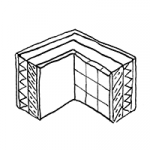
Depending on the software configuration, interdisciplinary scenario, and application objective, three different modeling approaches are used, each with its own advantages and disadvantages. These are described in more detail in the linked articles. To fully understand the following chapters, you should be familiar with the key technical background of these three methods.
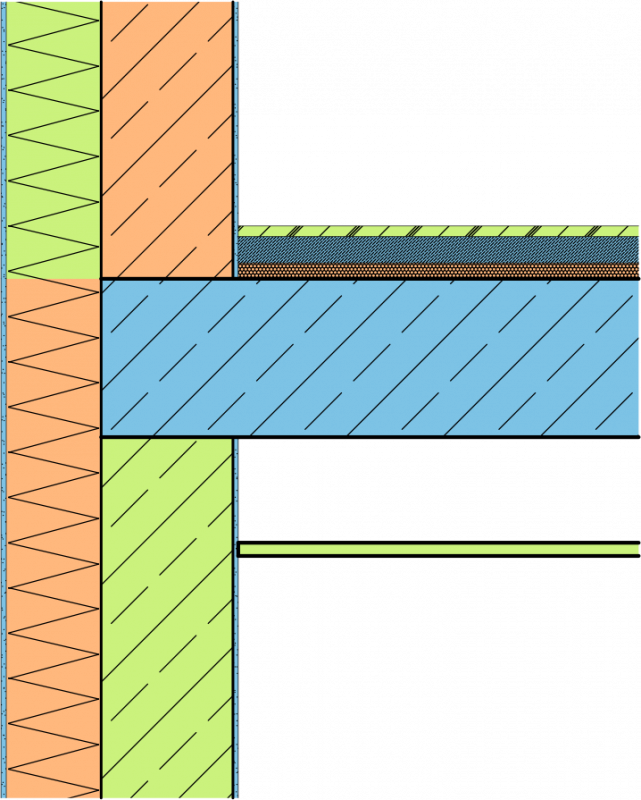
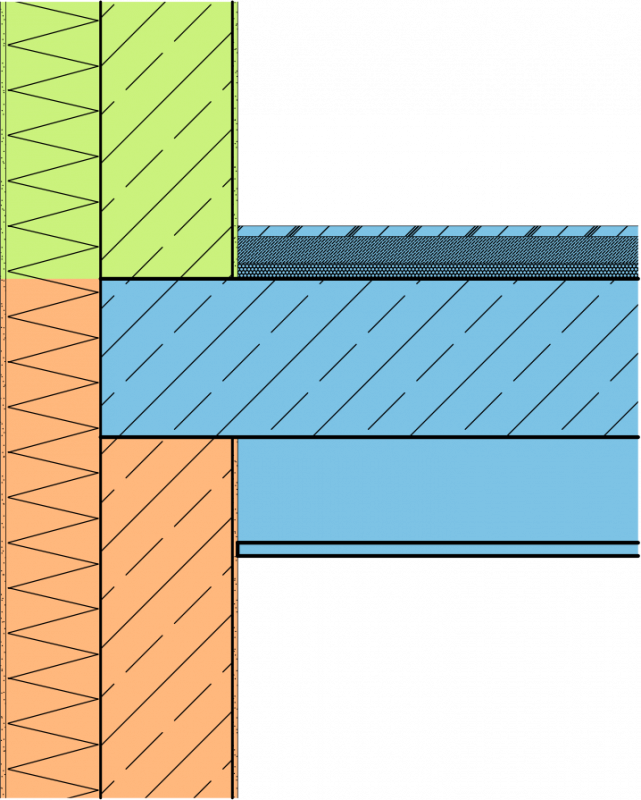
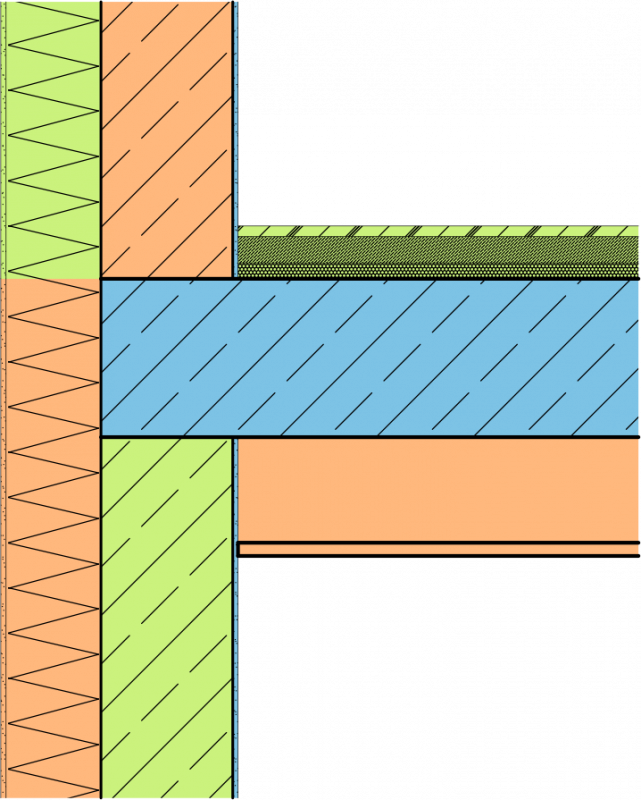
Unfortunately, nowhere are discipline-specific ways of thinking and requirements regarding the nature of digital models more clearly evident than in the question of the correct modeling approach for multi-layered components. One could almost put it this way: No matter how architects model—at least one downstream discipline will encounter a problem with the resulting data. Why is that?
The figure shows a small section of a typical residential building model. In such structures, a wide variety of layered constructions are typically found in a confined space:
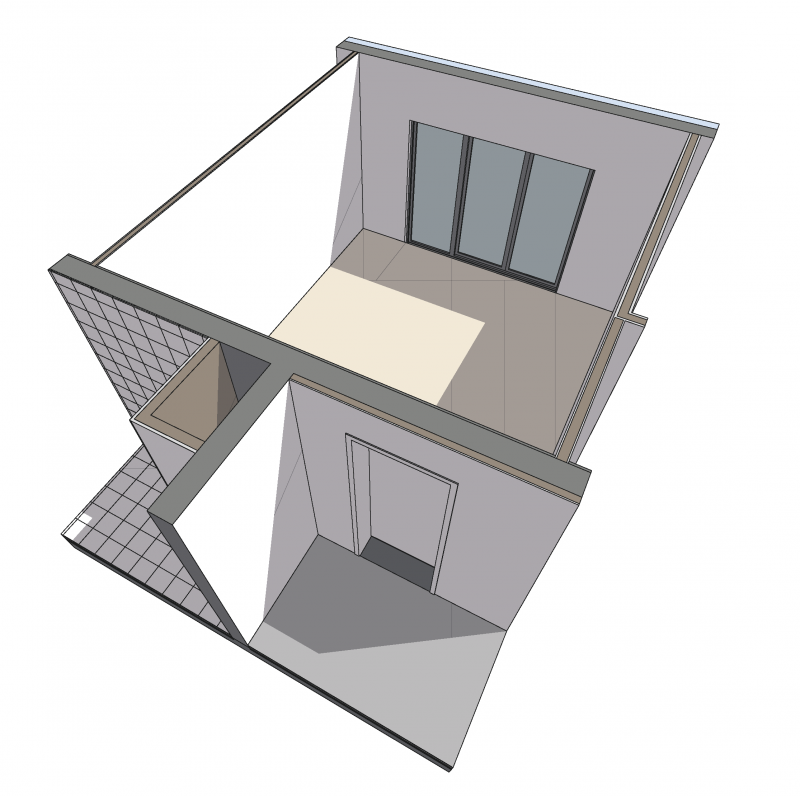
If you were to ask a structural engineer how they would model this, they would likely respond that all load-bearing components should be modeled separately or, at the very least, represented in isolation—for example, to generate formwork plans. Building physicists and building services engineers, on the other hand, rely on receiving structural composite systems as a “package”—since all simulation programs “expect” this. This also makes it easier for architects to manage, modify, label, and evaluate the various wall assemblies:
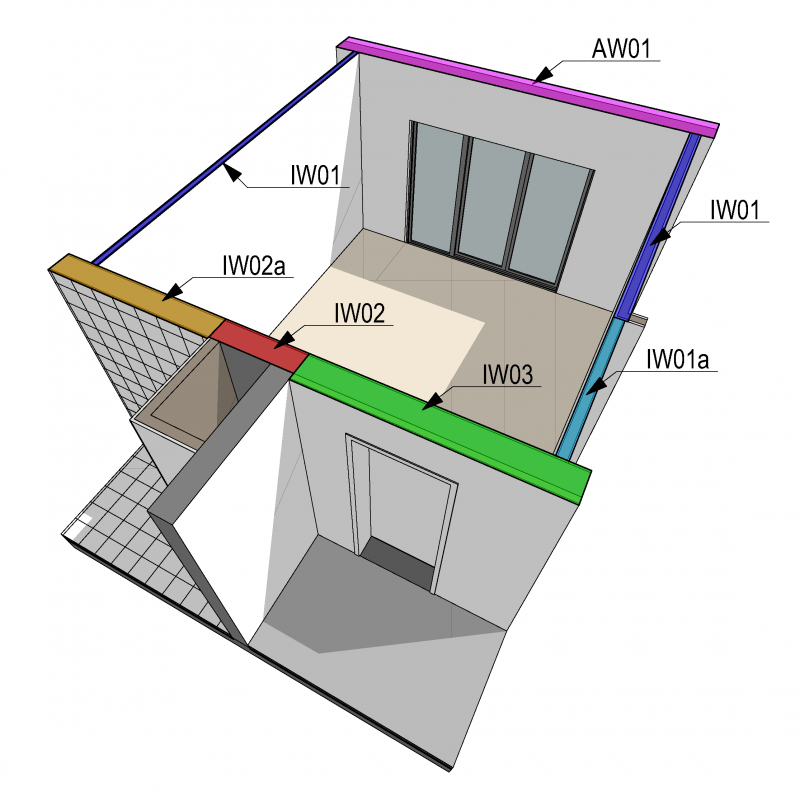
Using walls as an example, it is therefore relatively clear that a multi-layer modeling approach makes sense—the BIM software simply needs to be able to display the elements relevant to structural design in isolation. The situation is different, however, with horizontal components such as floors or roofs. Here, many users prefer the hybrid modeling approach. The following figure illustrates why:
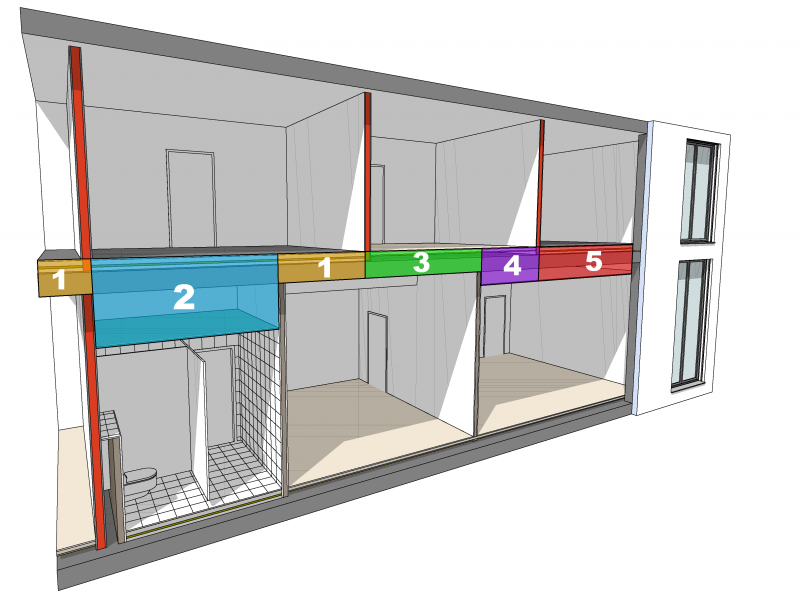
It is not uncommon for the floor plan to differ between two adjacent floors. Especially when—as shown in the example—suspended ceilings are planned for the lower floor, multi-layer modeling can quickly become tedious—the systems change within the same room, increasing the modeling effort. In addition, analyzing details—such as which floor construction is planned for a room—becomes time-consuming. Structural engineers would also be less than thrilled to receive what is essentially a continuous rough slab delivered in “separate parts.”
For the reasons mentioned above, horizontal structural elements are therefore usually modeled using a hybrid approach: the structural shell is modeled separately, with all finish layers grouped into “packages.” This enables fast, room-by-room workflows for modeling floor structures and suspended ceilings on a per-floor basis, as well as robust analysis capabilities. Structural engineers receive consistent structural slabs.
The only ones who suffer as a result of this very common practice are users of simulation software for building physics and building services engineering—they would also have to rely on multi-layer packages for horizontal building components, as illustrated in the figure. This is the only way to evaluate structural composite systems as a whole—after all, sound insulation indices, U-values, etc., apply to the entire system.
Summary
As described at the outset, it is clear that the various modeling approaches are rarely used in isolation, and regardless of the approach taken, one of the subsequent disciplines will usually have to deal with additional post-processing work—the key is to find the right strategy for the specific combination of partners and software involved in the project.
The choice of the right modeling strategy depends heavily on the capabilities of the authoring software being used > in this regard, there are significant technical differences between the various programs. While, for example, ArchiCAD and Allplan offer highly advanced features for multilayer workflows, Revit still has significant issues in this area.
However, beyond technical capabilities, other factors also play a role in determining the right approach:
- The Planning Phase
- The software configuration used in a project
- The BIM level of the individual planning partners
- The frequency of designated data exchanges between the planning disciplines
- The specifications of the BIM Execution Plan (BEP) and the Client Information Requirements (CIR)
- The designated review procedures of the BIM project coordination
- The client’s specifications for data transfer into a facility management program
Of course, planners cannot always adapt their working methods completely to such project conditions in every project; nevertheless, it is clear that even small adjustments to the modeling approach can often have a significant impact on interdisciplinary data transfers.
That said, best-practice solutions can certainly be identified across the various programs:
Early planning stages
In the early stages, Revit allows for multi-layer modeling—the technical limitations regarding material intersections and "parts" are not apparent in the black-and-white plan view. However, by the submission phase at the latest—when detailed, material-specific plan views are required in Germany and Austria—most users switch to a hybrid workflow. Revit offers various functionalities for breaking down multi-layer components into individual layers.
One challenge when transitioning from multi-layer to hybrid construction methods, however, is that components such as windows and doors must be designed so that their openings are "cut out" even within separate layers (such as a plastered insulation layer).
Since structural engineers work closely with or directly within the Revit model during the early phases, it is advisable to use the hybrid method from the start > Insulation layers still cannot be hidden in Revit 2017.
Late planning phases
Typically, modeling in Revit is done using a hybrid workflow starting no later than the submission stage. This makes it easy to graphically isolate structural elements so they can be accurately represented, for example, in structural foreman planning or formwork planning. Depending on the application scenario, single-layer workflows are also used, for example, when construction companies derive 4D or 5D simulations from a model.
Early planning stages
Even in the early stages of planning, ARCHICAD can fully leverage its advanced material intersection technology — here, you can work with multi-layer or hybrid modeling without hesitation, since multi-layer components (MSB) always access building materials and their intersection priorities.
Handoffs to structural engineering are streamlined by isolating MSB layers marked as "core" using the structural representation method, and building physicists and building services engineers also receive specially defined complete packages to which, for example, U-values can be easily assigned. The basis for reference details can be extracted just as easily.
The use of multi-layer components in modeling systems (e.g., master-slave systems) or for cross-project applications is possible at any time through the import and export of attributes.
Late planning phases
At the latest when a coordinated building physics catalog of structural systems is available, it should be incorporated into a project; this is always done using the Multi-Layer Components (MSB) system. If a simple multi-layer modeling method was used previously, the hybrid modeling method is recommended for horizontal building elements from this point forward.
A layer-based analysis is correspondingly easy to generate; changes made centrally improve workflow and minimize the risk of errors by eliminating the need for individual adjustments. The cutting priorities in the building materials used enable clean cutting as well as a clear graphical representation in combination with the model display.

Unfortunately, this content is available only to our Pro users.
If you'd like to read the full article, try the Pro account or become a Pro user.