
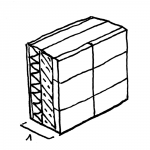
This article provides a general overview and description of the multi-layer modeling approach. It also outlines the advantages and disadvantages of this method.
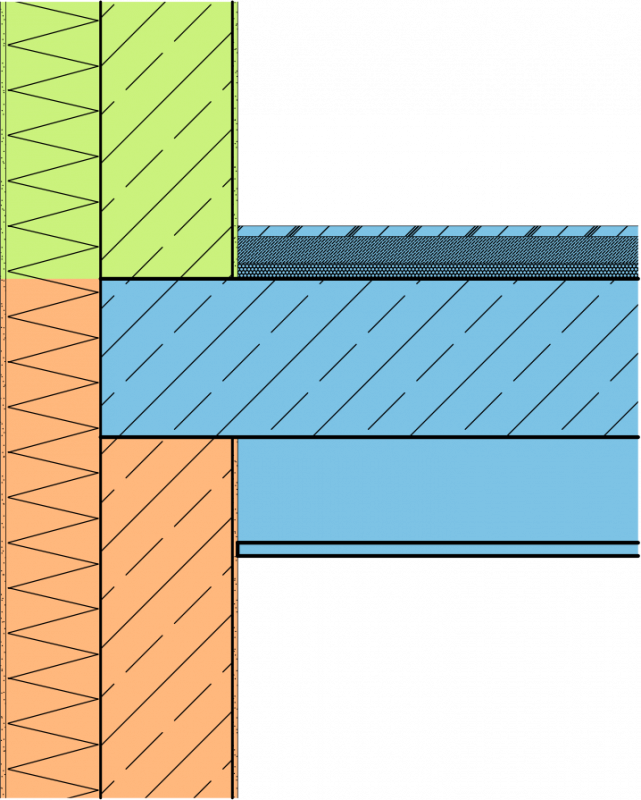
As a result, walls, ceilings, and roofs constructed in this manner provide ideal conditions for transferring data to building physics and building services simulation programs, which rely on precisely these attributes.
The labeling of wall types, which is standard practice in finishing planning in Austria and Germany, can be automatically generated (and updated) for multi-layer components using markers, thereby preventing errors when changes are made.
Understandably, making changes centrally is also significantly more efficient and reliable—for example, you can change the insulation thickness of a specific exterior wall type in its definition, and all model components will update “at the click of a button.” However, this option also carries a significant risk of error and should be left to the “experts” in office environments.
Nevertheless, multi-layer models do not offer only advantages. In particular, when working with horizontal components such as floor-ceiling assemblies, drawing in layers can be quite cumbersome (e.g., when two floors have different room layouts, see above). Even with long walls featuring different structures (e.g., along a central corridor in a residential building with adjacent bathroom clusters), consistent multi-layer modeling can be quite labor-intensive.
Unfortunately, some BIM programs still have trouble correctly intersecting components with different layers or graphically isolating individual layers—which is why hybrid modeling is often used as a workaround.
Search terms: Multilayer, component, layer, composite, modeling method, single, hybrid, layered structure, operating principle, strategy, modeling, parts, MSB, dummy
Advantages
- Minimal modeling effort
- Minimal effort required for modifications – centrally controllable
- Few sources of error during modifications
- Automated labeling (and modification) of component types
- Evaluation by type very easy to implement (“Component Catalog”)
- Central attribute management (e.g., U-value, fire protection, etc.)
- Easy data transfer to simulation from MEP and building physics
Disadvantages
- Complex layer-by-layer analysis
- Complex 4D and 5D simulation
- Unfavorable workflows in some areas, especially for horizontal components.
- Centralized changes carry a risk of errors
- Software-related: Potential issues with intersecting different components or with the graphical isolation of individual layers
- Software-related: Potential issues during handoff to structural analysis (e.g., when insulation layers cannot be hidden)