
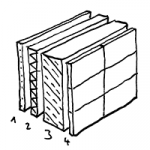
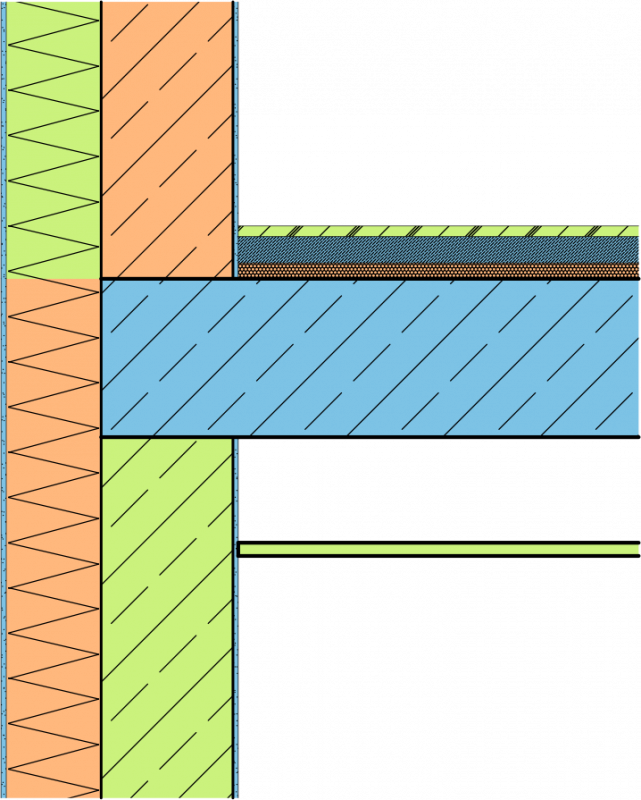
In single-layer modeling, each layer of a composite building system (such as an insulated, load-bearing exterior wall) is modeled individually. Thus, for a four-layer wall (e.g., plaster – insulation – concrete – plaster), four separate, directly adjacent walls are modeled.
Since four walls are treated as a single wall, achieving accurate modeling results requires a significant amount of technical effort, particularly when dealing with openings such as cutouts, doors, or windows. The labeling of wall types, for example—which is standard practice in finishing planning in Austria and Germany—easily becomes a Sisyphean task with this method; it is manual work and highly prone to errors.
The potentially high cost of modeling and making changes associated with this approach might initially cast doubt on whether single-layer modeling is a practical method—yet it does have its merits:
For one thing, some BIM programs still have significant technical issues with graphically isolating individual layers (e.g., the concrete core of a wall) or automatically intersecting adjacent, multi-layer systems (e.g., when connecting a tiled interior wall to a plastered exterior wall) — these then lead to graphical representation issues and, in some cases, to incorrect quantity takeoffs.
On the other hand, there are certainly use cases where a layer-specific analysis and evaluation offer significant advantages—for example, when construction companies use a 4D construction simulation or a model-based 5D quantity takeoff as a basis for billing. This, in turn, is extremely difficult to achieve in some BIM programs that specialize in multi-layer workflows.
Nevertheless, single-layer modeling is not a particularly recommended approach, especially in the early planning phases, as changes are time-consuming and prone to errors. In addition, single-layer models are practically unusable for collaboration with building physics and MEP—all simulation programs used here “expect” multi-layer components.
Search terms: single layer, single, modeling method, model, layer, composite, single, hybrid, layered structure, working method, strategy, parts, MSB, dummy
Advantages
- Very easy to learn, straightforward
- No mixed forms (as in hybrid modeling, for example)
- Graphical isolation of layers is very easy to achieve (e.g., the concrete core of an insulated exterior wall for formwork or reinforcement planning)
- Very easy to determine areas and volumes layer by layer
- Virtually no technical issues with intersections of different structures
- 4D simulation of construction phases is very easy
- 5D simulation of required or delivered quantities is very easy
Disadvantages
- Extremely time-consuming modeling
- Very high modification effort
- Labeling of types is done manually and prone to errors
- High risk of errors (when making changes: were all insulation thicknesses really updated?)
- Problematic in the area of openings (penetrations, windows, doors)
- Poor analyzability by type (e.g., how many m² of wall type AW01?)
- Data transfer to building physics and building services simulations is extremely problematic (e.g., where is a wall’s U-value defined?)