
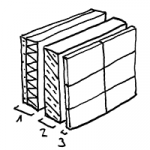
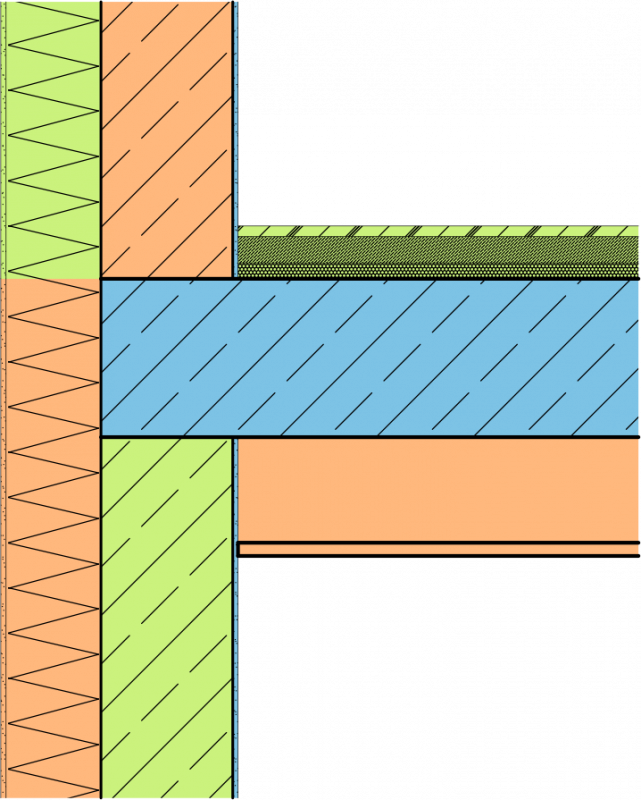
In hybrid models, structural elements such as floor slabs are modeled separately, while all other building components are modeled as multi-layer assemblies, such as a floor structure.
The hybrid modeling approach thus combines the advantages and disadvantages of single-layer and multi-layer modeling: Load-bearing elements can be easily isolated, providing a solid data foundation for structural calculations or formwork and reinforcement planning. Conversely, hybrid models pose challenges for collaboration with building physics and MEP engineering—all simulation programs used here “expect” multi-layer components, and hybrid models require extensive post-processing before handover.
Packages such as flooring or roof structures can be managed and analyzed centrally, which offers advantages in terms of automated labeling, changes, and analysis.
Search terms: Multilayer, modeling method, model, layer, composite, single, hybrid, layered structure, approach, strategy, parts, MSB, dummy
Advantages
- Standard modeling effort
- Normal modification effort
- Good workflow for horizontal components (e.g., modeling floors room by room)
- Simplified evaluation Labeling of individual types (e.g., floor packages)
- Simple data transfer to structural engineering
Disadvantages
- Labeling body types is a manual process and prone to errors
- Problematic in the area of openings (openings, windows, doors)
- Difficult to analyze by type (e.g., how many m² of wall type AW01?)
- Data transfer to building physics and building services simulations is extremely problematic (e.g., where is a wall’s U-value defined?)