
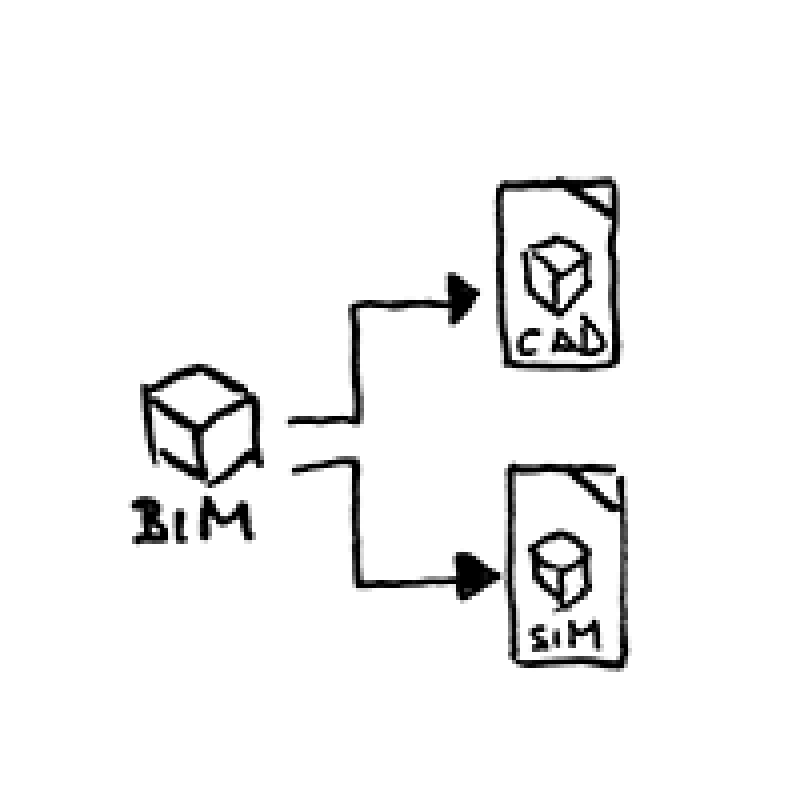
The term "interface," which is used somewhat loosely in the construction industry, refers in the BIM workflow to tools and formats for transferring data between two programs (e.g., from authoring software to verification software) or even between two systems (e.g., from software to a manufacturing machine such as a 3D plotter or a CNC milling machine).
Although, in principle, any method of converting data from one format to another is referred to as an interface, this section will focus only on the interfaces most relevant to the BIM world (and will not cover formats such as DWG, STP, or similar formats).
Open interfaces are designed to enable data transfer across software platforms. They form the technical backbone of the Open BIM approach. They are based on the idea of standardizing the objects and attributes of digital building models, thereby enabling cross-platform data exchange. The most important open formats in the BIM workflow are the Industry Foundation Classes (IFC) and the Green Building XML format (gbXML).
Proprietary interfaces refer to solutions for the direct transfer of data between two programs or systems. Typically, open formats are not used in this context; instead, data is transferred directly using plug-ins.
The use of proprietary interfaces often results in fewer "friction losses" than the use of open interfaces, because data can be transferred with greater "intelligence" than, for example, the IFC format allows. For this reason, many software manufacturers—especially in the field of simulation tools—now rely on solutions for direct data transfer via plug-ins into authoring software.
The problem with this trend is that many manufacturers rely solely on a single tool (such as Revit) and do not pursue the development of open interfaces, which leads to major problems, especially in the Open BIM workflow—for example, when the necessary software is not available in the project setup.
For more information on this topic, see the article "Overview of IFC Interfaces."