

The IFC format is an open data standard used in the construction industry to describe components in digital building models (Building Information Modeling). It enables the exchange of information between various CAD solutions and other systems in the construction and building management sectors.
This format is defined by buildingSMART (formerly IAI – International Alliance for Interoperability), an association of stakeholders from the construction industry and software development that now has over 600 members in 17 regional chapters around the world.
The Industry Foundation Classes are registered under ISO 16739 and can be integrated into any quality assurance strategies in your environment.
The IFC format is used to capture 3D model content and its associated alphanumeric information in a readable data set (ASCII), thereby enabling the exchange of information between different programs. The model components are organized into logical building structures, e.g.,
- Wall on a floor in a building
- Opening in a wall on a floor in a building
- Door in an opening in a wall on a floor in a building
- etc.
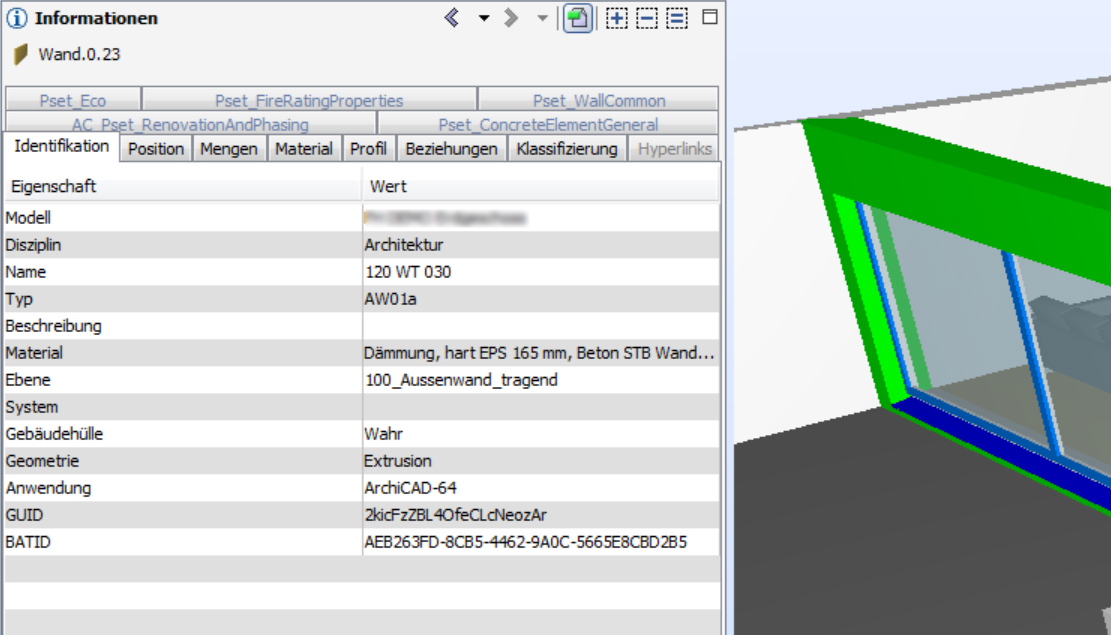
The alphanumeric attributes (in Austrian German: Merkmale) of the model components are organized in what are known as property sets. Taking a wall as an example, these include material, U-values, structural properties, etc.
The figure shows an example of a set of such property sets for the wall selected here. (Each tab in the left-hand information pane corresponds to a property set, or "P_Set" for short.)
Since the IFC format conveys both 3D data and alphanumeric information about the model components (and thus essentially all "BIM data"), it is often mistakenly regarded as a universal interface. It is expected that a BIM object can be transferred from one software application to another with all its “intelligence” intact.
However, anyone familiar with BIM software understands that all objects (in Revit: "families") within a program are, by their very nature, small mini-programs within the larger program: For example, an architect or structural engineer can design a beam as an object that becomes taller as its length increases. They define the formula for this within their BIM authoring software. If this “intelligent” beam is now exported to IFC, the 3D geometry and properties (e.g., material, load-bearing capacity, etc.) are transferred correctly—but unfortunately not the intelligence of the formula “longer = taller.” If they then import this IFC back into their model, this “intelligence” is no longer present.
This simple example highlights the limitations of the IFC data format—3D information and features are not the only data contained in an intelligent virtual component.
Since the release of IFC 4, IFC has been an official ISO standard—ISO 16739-1:2018.
Programs supported by the IFC:
https://technical.buildingsmart.org/community/software-implementations/
Overview of IFC data types:
https://technical.buildingsmart.org/standards/ifc/ifc-formats/
Overview of BIMpedia content on IFC:
IFC Model View Definitions
https://www.buildingsmart.org/standards/bsi-standards/model-view-definitions-mvd/